- 3 semester
- Hybrid
- Credits 36
- Part-time
- Start date: August 10, 2026
- SNIES code: 105493


The Master’s in Urban and Regional Planning prepares professionals to analyze, design, and manage public policies and urban and regional projects aimed at improving quality of life in cities and territories. It addresses challenges such as sustainable mobility, housing, the environment, and economic development.
The master’s curriculum combines theoretical and practical courses covering topics such as strategic planning, project management, social and urban research, environmental impact assessment, mobility and transportation, housing, and economic development.
You can pursue your master’s degree without giving up everything that matters to you. We offer flexible schedules and a hybrid format that combines synchronous virtual meetings and in-person sessions, so you can progress in your studies with the balance you need.
Meetings every 15 days, with some in-person sessions and others held virtually.
The final schedule and class days depend on the courses you enroll in.
We know that personal life is as important as academic life, so you can choose as many credits as you consider appropriate, according to your available time and budget.

*Weeks without an assigned P or V indicate that there will be no classes during those weeks.
Thursdays and/or Fridays during the time slots from 7:00 a.m. to 10:00 a.m. or from 5:00 p.m. to 8:00 p.m
Saturdays between 7:00 a.m. and 1:00 p.m.
Virtual sessions
Thursday and/or Friday between 6:30 a.m. and 8:00 p.m
Saturdays from 7:00 a.m. to 1:00 p.m.
In-person sessions
Students in this master’s program may choose one of the following degree options: an academic article, a public policy document, or a consulting or social innovation project.
Consulting. Diagnoses and alternative solutions to problems proposed by public organizations, civil society organizations, and companies.
In addition, by taking certain specific elective courses suggested by Cider, students may obtain a special certificate awarded by the University by completing and passing 8 credits in one of the following concentrations:
The graduate is a professional capable of deeply understanding the problems and challenges of territorial planning, analyzing urban and regional dynamics from a critical, interdisciplinary perspective grounded in the Latin American context. The graduate has the skills to interpret regional development processes, assess impacts on land-use planning, and propose comprehensive solutions in areas such as sustainable mobility, housing and habitat, territorial management, and urban public policy, addressing the social, environmental, and economic challenges facing cities and regions.
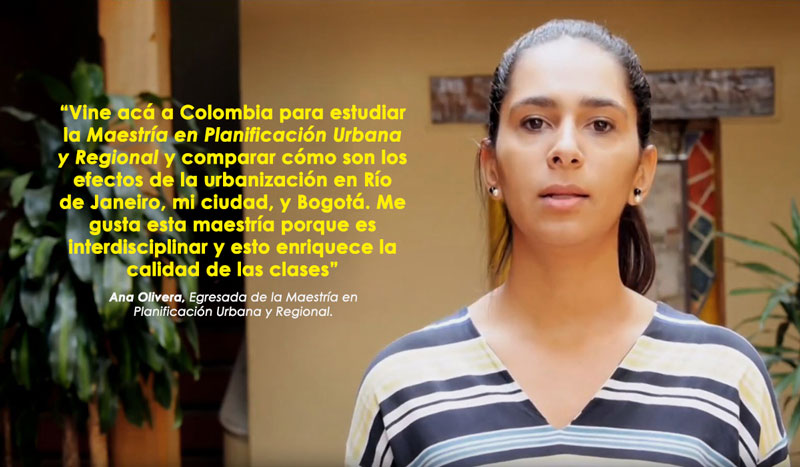
The master’s program addresses urban planning, regional development, sustainable mobility, housing and habitat, land-use planning, environmental impact assessment, and urban project management. It combines theory and practice to analyze and transform cities and territories in Latin America.
It is intended for professionals from diverse disciplines who are interested in understanding and addressing urban and regional challenges from a critical, interdisciplinary, and comprehensive perspective, especially in the contexts of Colombia and Latin America. It is ideal for those who wish to influence urban public policy, territorial management, and sustainable development.
The program offers two concentrations: Mobility and Housing, and Habitat. These tracks allow students to explore key topics in contemporary urban planning in greater depth and develop applied skills for managing territory and formulating urban projects.
There are two degree types: research, which can be carried out through an academic article or a public policy document; and specialization, based on applied consulting. Both options strengthen competencies in urban analysis, spatial planning and informed decision-making.
Double degree programs:
Depending on the case, you may be able to complete 2 master’s degrees by taking between 45 and 48 credits in total, rather than 74 credits (the total required separately), approximately 40% fewer credits. This translates into a lower financial investment and a lighter academic workload while earning 2 master’s degrees.
Some of the programs that are most closely related for pursuing these double degree programs are the Master’s in Peacebuilding, the Master’s in Gender, the Master’s in Interdisciplinary Studies on Development, the Master’s in International Law, and the Master’s in Education.
Credit transfer:
Students in the Specialization and Master’s programs may transfer credits earned in any of the programs offered by Cider or in another program outside the University, provided that they meet the requirements established in the University’s Credit Transfer and Validation Regulations.
The credit transfer request must be formally submitted here. for review and approval by Cider’s Academic Coordination Office.
Microcredentials and transferable Continuing Education courses:
If, for any reason, you are unable to enter this program directly, you can enroll in one of the Microcredentials and/or transferable courses* offered by Cider through the Directorate of Continuing Education at the University of the Andes. Once you complete and pass the Microcredential or course, you may request the transfer of academic credits from the Academic Coordination Office of Cider. For more information, consult the current course catalog here.
*Does not apply to all courses offered by Continuing Education; only to certain specific courses.
*Does not apply to regular students at the University of the Andes.

Academic mobility:
Students interested in national or international academic mobility opportunities can apply through the Office of Internationalization at Universidad de los Andes using the following links: https://internacionalizacion.uniandes.edu.co/estudiante-maestria-uniandes-intercambio-internacional and https://uniandes.adv-pub.moveonca.com/home-page-2702/
Study in the Netherlands:
Complement and strengthen your education by taking up to two elective courses in the Master’s in Development Studies at the International Institute of Social Studies (ISS), part of Erasmus University Rotterdam, in The Hague, the Netherlands.
More information here: The International Institute of Social Studies opens its doors to students from Cider’s Master’s programs
Applications open: July 27
$1,890,000 COP
$500 USD*
*Approximate investment in U.S. dollars; this may vary according to the day’s exchange rate.
**The semester investment amount depends on the number of credits in which the student enrolls.
**The 2027 investment amount will be determined at the end of 2026, based on the variation in the Consumer Price Index (CPI).
* Admission confirmation is an advance payment of $2.000.000, which secures your place in the program to which you have been admitted by the university.
*This amount will be deducted from the total tuition.
*If the applicant ultimately does not enroll at the university, this money will not be refunded.
The University offers several financing options to help you begin your studies. Many of our students receive scholarships, loans, or some form of financial assistance.
Cubre hasta el 90% del valor de la matrícula. Puede incluir apoyo económico para vivienda y sostenimiento.
Cubre hasta el 100% del valor de la matrícula.
Descuento dirigido a contratistas y funcionarios públicos. Consulta las condiciones y requisitos para acceder al beneficio.
Descuento dirigido a colaboradores de la Cruz Roja en Colombia. Consulta las condiciones y requisitos para acceder al beneficio.
Financia entre el 50% y hasta el 80% de la matrícula de estudiantes actuales o que estén en proceso de admisión.
Cubre el 5% del valor de la matrícula para egresados formales de Pregrado, Maestría y Especialización.
Préstamo por el 80% del valor de la matrícula. Puedes pagar el capital hasta en 48 meses.
Pagas una parte de tu matrícula mientras estudias y el porcentaje restante después de graduarte.
SUFI-Bancolombia, Fincomercio, Davivienda y JFK (cooperativa financiera).

Profesor de planta
Profesora de cátedra
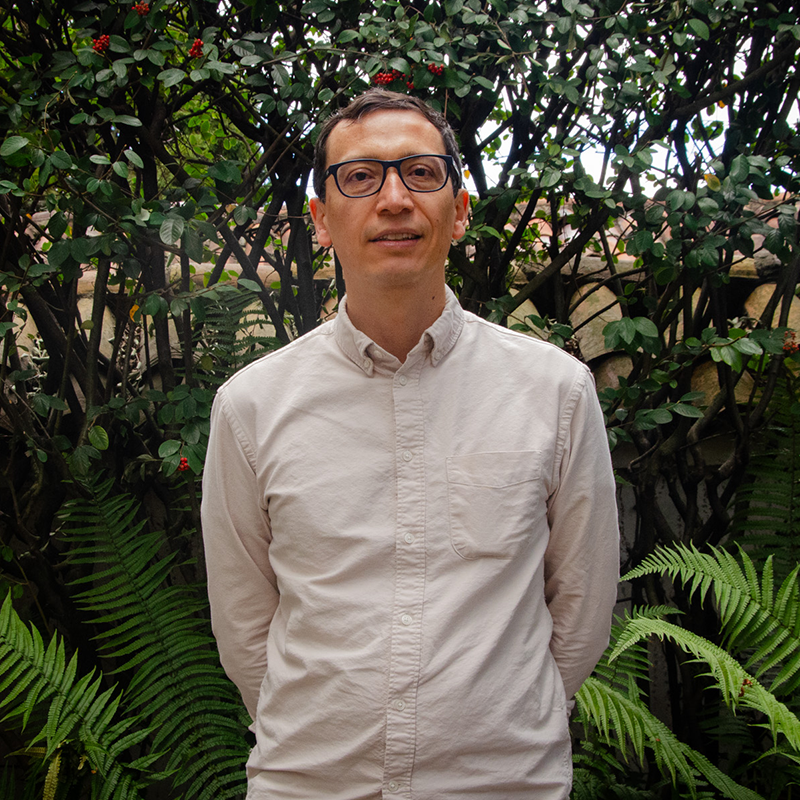
Profesor de planta
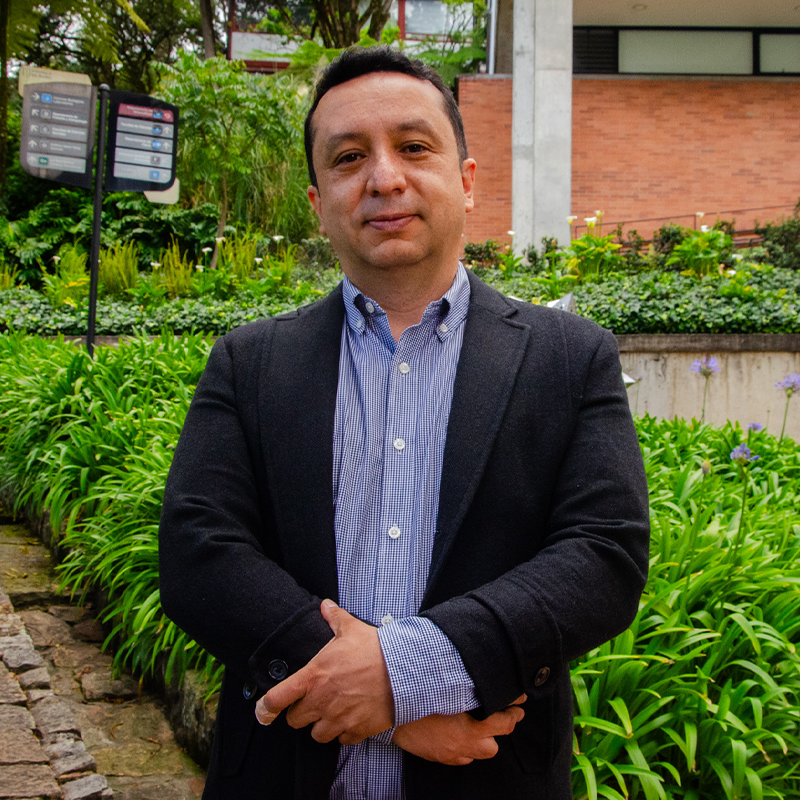
Profesor de planta
Remember that we are here to help you every step of the way. Write to us with your details, the program to which you are applying, and your question at:

Nataly Guanumen Rodríguez
Applicant Experience Advisor
📩 ln.guanumen@uniandes.edu.co
📞Extension 601 665 13 19 Ext: 2669
🏦Office GB-401
You can also contact us via WhatsApp
Under Decree 1067 of May 26, 2015, and Resolution 714 of June 12, 2015, issued by the Ministry of Foreign Affairs, foreign students who intend to study in Colombia must have a Student Visa or another type of visa that permits them to study. This visa must be presented to the Office of Admissions and Registration at Counter 4 or sent to extranjerosuniandes@uniandes.edu.co, with a copy to cidergestor2@uniandes.edu.co, in order to meet this legal requirement. It is important to complete this process before printing your tuition payment receipt. In addition, current Colombian law requires foreign nationals, both adults and minors, who hold a visa valid for more than three months to carry a foreigner ID card as an identity document. Therefore, you must also obtain this document and may submit it together with your visa.
Please remember that you need to complete your visa application well in advance to avoid any issues with tuition payment and enrollment registration. If you would like to learn more about the visa process in Colombia, you can visit the following page of the Ministry of Foreign Affairs: https://www.cancilleria.gov.co/tramites_servicios/visa/abece-visas . If you have any questions about the visa process, please contact us by telephone at 3394949 Ext. 2211 – 2298 or by email at extranjerosuniandes@uniandes.edu.co, and we will provide you with the relevant information.